

In A Country Without Fathers or Husbands? Author and researcher Zhou Huashan explores the traditional culture and social life of the Mosuo, a people living primarily in the region around Lugu Lake on the Yunnan–Sichuan border. Focusing on matrilineal kinship, household life, gender relations, and intimate partnerships, Zhou examines how Mosuo people understand their own social institutions and how these differ from conventional Chinese family models. In traditional Mosuo society, maternal households provide the foundation of family membership and shared responsibilities, while men and women may maintain intimate relationships through the practice commonly known as tisese, or visiting relationships, without necessarily establishing a conjugal household. Zhou pays particular attention to the idea of valuing women without diminishing men, emphasizing that matrilineal organization should not automatically be equated with female domination. He also challenges popular misconceptions that visiting relationships imply an absence of emotional commitment, family responsibility, or social order. By foregrounding cultural values and lived experience, the book offers a more nuanced understanding of Mosuo identity and examines the pressures that modernization, tourism, and changing social expectations place on traditional practices.
To compare with A Society Without Fathers or Husbands: the Na of China by Cai Hua, these two works provide complementary perspectives on one of the most distinctive kinship systems in China. Cai Hua approaches Na society primarily through the theoretical framework of social anthropology, questioning whether institutionalized marriage and conventional fatherhood are necessary foundations of family organization. Zhou Huashan places greater emphasis on cultural interpretation, gender relations, and the lived experiences through which Mosuo people understand their families and relationships. While Cai Hua investigates the structural logic of a society organized around maternal kinship, Zhou explores the meanings, values, and misconceptions associated with this way of life. Both books challenge the assumption that the nuclear family is the universal or inevitable model of human social organization, demonstrating instead that kinship, intimacy, and responsibility can take different forms across cultures. At the same time, their accounts invite readers to distinguish between formal social conventions and the diverse realities of individual lives. Together, they offer valuable resources for understanding matrilineal societies, comparative family studies, gender anthropology, and the cultural diversity of southwestern China, while encouraging a broader reconsideration of marriage, parenthood, and the many ways human communities organize their social worlds.
Text in Chinese.
2001, published by Guangming Ribao Chubanshe, paperback, 372 pp., used in a good condition.
| Book Details | |
| Author | Zhou Huashan |
| Publisher | Guangming Ribao Chubanshe |
| Publication Date | 2001 |
| ISBN | 9787801453655 |
| Format | softcover |
| Pages | 372 |
| Language | Chinese |
| Condition | Used in a good condition |
A Society Without Fathers or Husbands? by Zhou Huashan
- ISBN: 9787801453655
- Availability: In Stock
-
US$10.00
Related Products
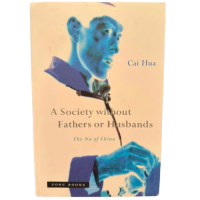
A Society Without Fathers or Husbands: the Na of China, by Cai Hua
A Society Without Fathers or Husbands: The Na of China by anthropologist Cai Hua is a landmark study..
US$25.00
Tags: A Society Without Fathers or Husbands? by Zhou Huashan