

Szechwan and the Chinese Republic: Provincial Militarism and Central Power, 1911–1938 examines the complex relationship between regional military power and the central government during one of the most turbulent periods in modern Chinese history. Following the collapse of the Qing dynasty in 1911, the new republic struggled to establish effective national authority, while provincial military commanders increasingly controlled local politics, administration, and economic resources. Sichuan (Szechwan), with its vast territory, substantial population, and relative geographic isolation, became a particularly important arena for the development of provincial militarism. The province's political history illustrates the difficulties of transforming a fragmented imperial state into a unified modern nation.
The book explores the rise of competing military factions in Sichuan, their struggles for territorial control, and their shifting relationships with successive central governments. Provincial commanders frequently pursued their own political and military interests, while the central authorities sought to extend their influence through negotiations, appointments, military campaigns, and administrative reforms. These competing ambitions produced recurring conflicts and shifting alliances that shaped the province's political and economic development. By examining the interaction between local power structures and national political initiatives, the study reveals how regional militarism both challenged and influenced the evolution of the Chinese Republic. It also highlights the importance of Sichuan as a strategic inland province during the Nationalist government's efforts to consolidate state power in the 1920s and 1930s.
Covering the period from the 1911 Revolution to the eve of the Second Sino-Japanese War, this work provides valuable insights into the fragmentation of Republican China and the enduring tensions between regional autonomy and national integration. It is an important reference for scholars and readers interested in modern Chinese political history, military institutions, warlordism, and the development of provincial governance. By focusing on Sichuan, the book offers a regional perspective on the broader challenges of state-building in twentieth-century China, demonstrating how the struggle between provincial military leaders and central political authorities shaped the country's turbulent transition toward modern nationhood.
1973, Yale University Press, hardcover, 198 pp., small tear at the bottom of right corner of the dustjacket, overall in a good condition.
| Book Details | |
| Author | Robert A. Kapp |
| Publisher | Yale University Press |
| Publication Date | 1973 |
| ISBN | 9780300016048 |
| Format | hardcover |
| Pages | 198 |
| Language | English |
| Condition | small tear at the bottom of the right corner on dustjacket, overall in a good condition |
Szechwan and the Chinese Republic: Provincial Militarism and Central Power, 1911–1938, by Robert A. Kapp
- Publisher: Yale University Press
- ISBN: 9780300016048
- Availability: In Stock
-
US$45.00
Related Products
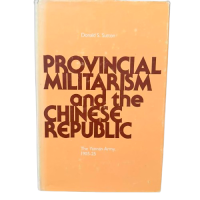
Provincial Militarism and the Chinese Republic : The Yunnan Army, 1905-1925, by Donald S. Sutton
Provincial Militarism and the Chinese Republic: The Yunnan Army, 1905–1925, is a major study of the ..
US$50.00
Tags: Szechwan and the Chinese Republic: Provincial Militarism and Central Power, 1911–1938, by Robert A. Kapp